Cavtat Coastal Defence Tunnels Sustjepan
A Cold War Artillery Position on the Rat–Sustjepan Peninsula

Peter Swart
June 2026
Introduction
Near the tip of the Sustjepan Peninsula at Cavtat, Croatia, a largely forgotten military tunnel complex lies hidden beneath the limestone headland overlooking the entrance to Župa Bay and the sea approaches to Dubrovnik. Although well known to generations of locals and visitors, the site has received little formal documentation in English.
The complex consists of approximately 70 metres of interconnected concrete-lined tunnels, nine underground rooms, several gun positions, and an elevated observation post. The surviving structures appear to form part of a Second World War/Post WWII coastal defence system established by Italians and later used by Yugoslavia during the early years of the Cold War.
The tunnels occupy a strategically significant position. From the headland, artillery could command shipping approaching Cavtat while observers enjoyed extensive views across the Adriatic towards Dubrovnik and the offshore islands while remaining hidden.
Figure 1: A: View from main tunnel entrance; B View from a gun emplacement towards Supetar Island with Dubrovnik in the background. |

Tunnel Layout
The tunnel system is arranged on several levels connected by stairways and a vertical shaft. The lowest entrance lies approximately 15 metres above sea level and leads into a straight tunnel running roughly south into the limestone bedrock. This passage is about 20 metres long and forms the principal access route into the complex.
Figure 2: A:Main passage looking back towards the entrance; B: Stairs at the end of the main passage leading to the upper level. |

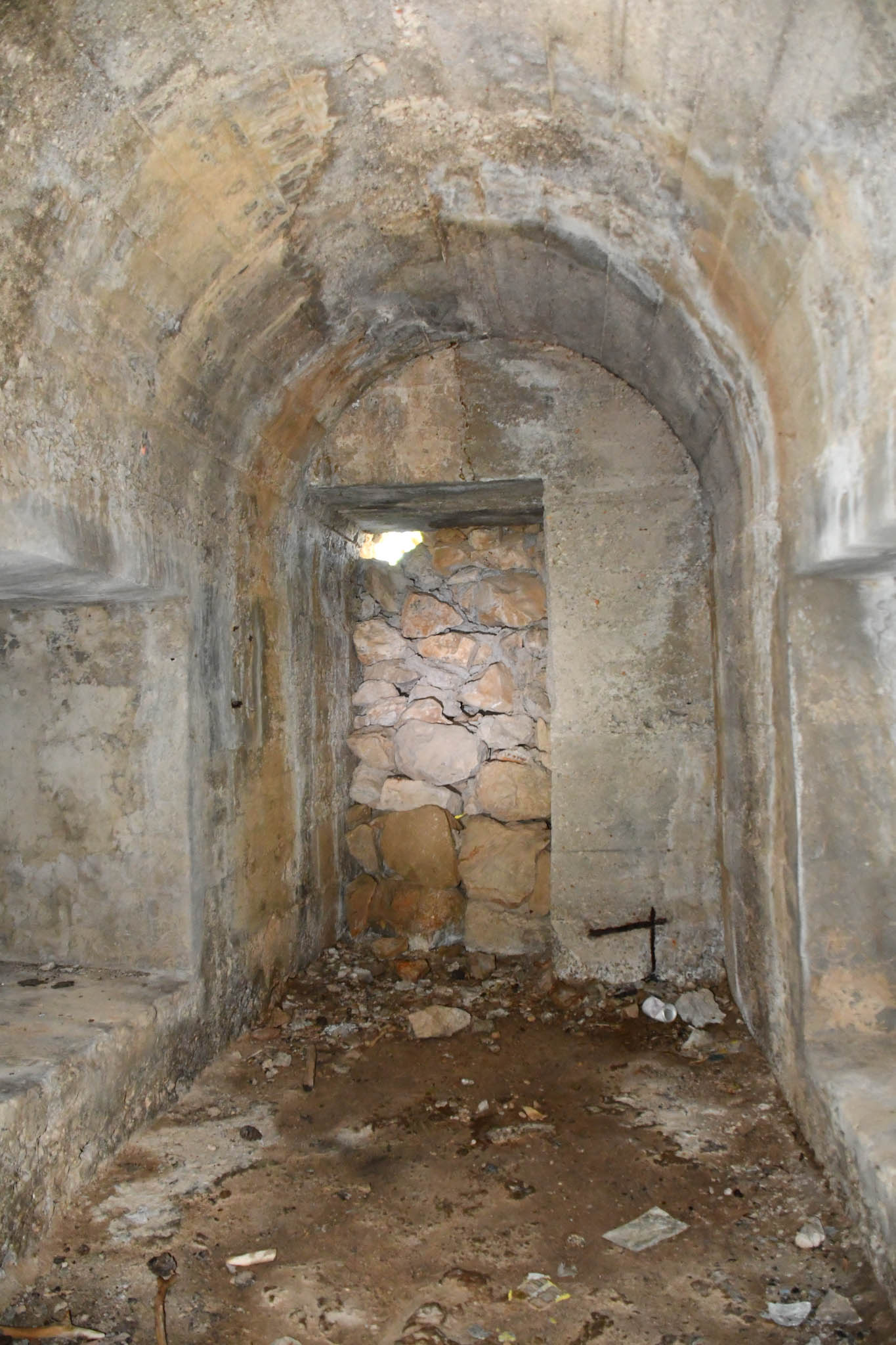
At the southern end of the entrance passage, a right-angle turn leads to a staircase where 24 steps lead to the upper levels. Before the end of the main passage, a cross-passage leads to rooms, passages and other entrances. From here the tunnel branches into two arms, each leading to more rooms, staircases and yet higher level entrances and gun positions.
A total of five entrances were found. In addition to the main entrance, there are three entrances that emerge directly adjacent to circular concrete gun emplacements. Another entrance has subsequently been blocked with stone.
At the top of the first staircase, a passage to the left leads to a room containing numerous wall-mounted bolts and attachment points. The original function is uncertain, but the evidence suggests the installation of communications, electrical or fire-control equipment. For convenience, this room is referred to here as the "control room".
Figure 3: A View port; B: Bottom of ladder; C: Ladder ascending to the observation post platform. The dot in the top right corner is a horseshoe bat. |

The most interesting feature is a secondary passage leading to a vertical shaft approximately 10–12 metres high. Iron staples embedded in the wall form a ladder giving access to a small observation post. The observation chamber contains low horizontal viewing slits on three sides, indicating a surveillance function. The views are currently blocked by dense vegetation. The view ports are close to the surrounding ground, which would make this post very difficult to spot from a distance.
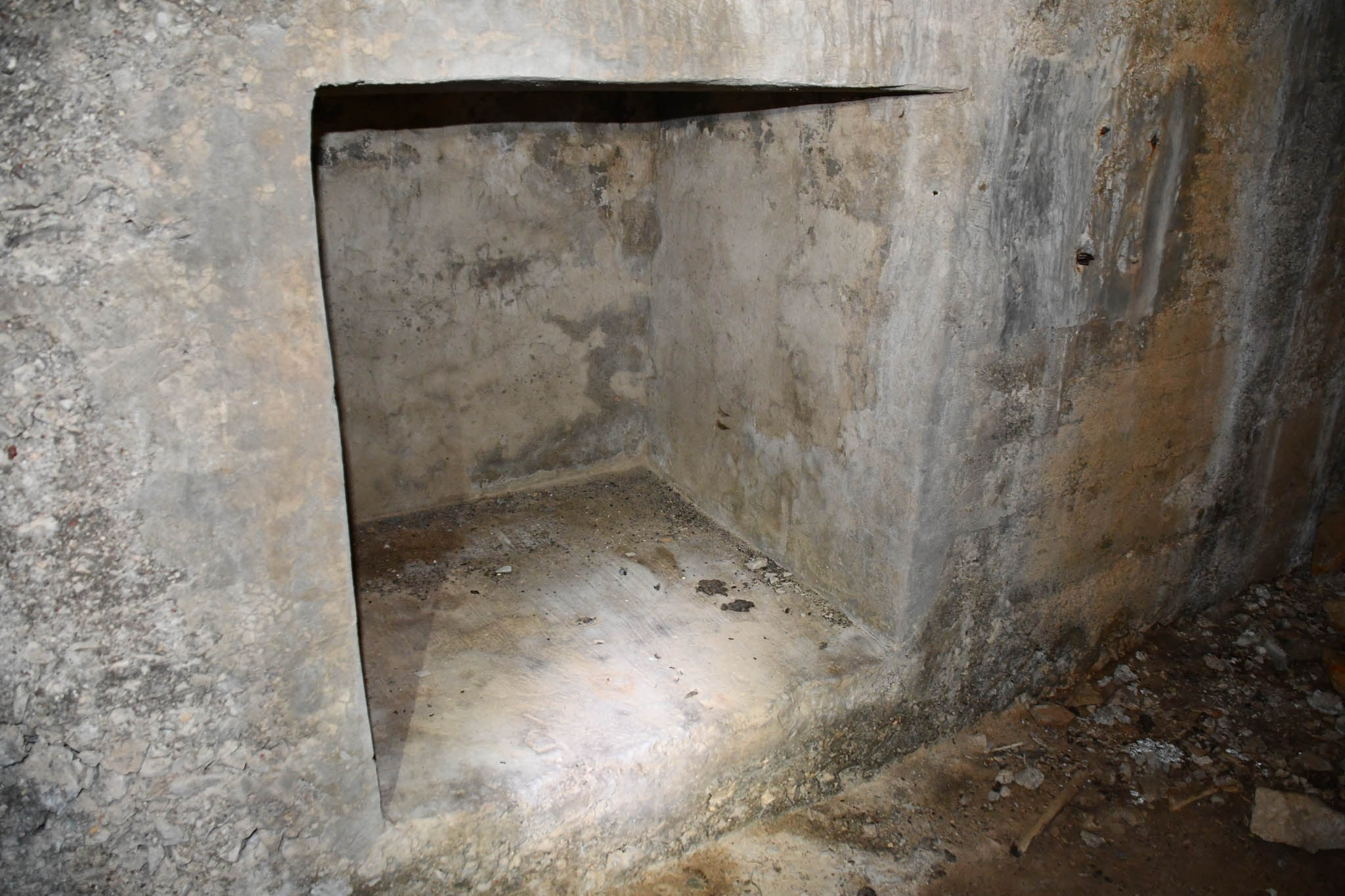
At each entrance that leads to a gun emplacement, a 1m x 1m x 1m alcove is built into each passage wall. These are about half a metre above the floor level. A few metres further back into the tunnels are floor to ceiling concrete pillars. These fill about two thirds of the width of the passage and appear to be blast protectors.
Figure 4: View looking into an upper-level gun emplacement entrance. Alcoves on the left and right and blast wall further back. |

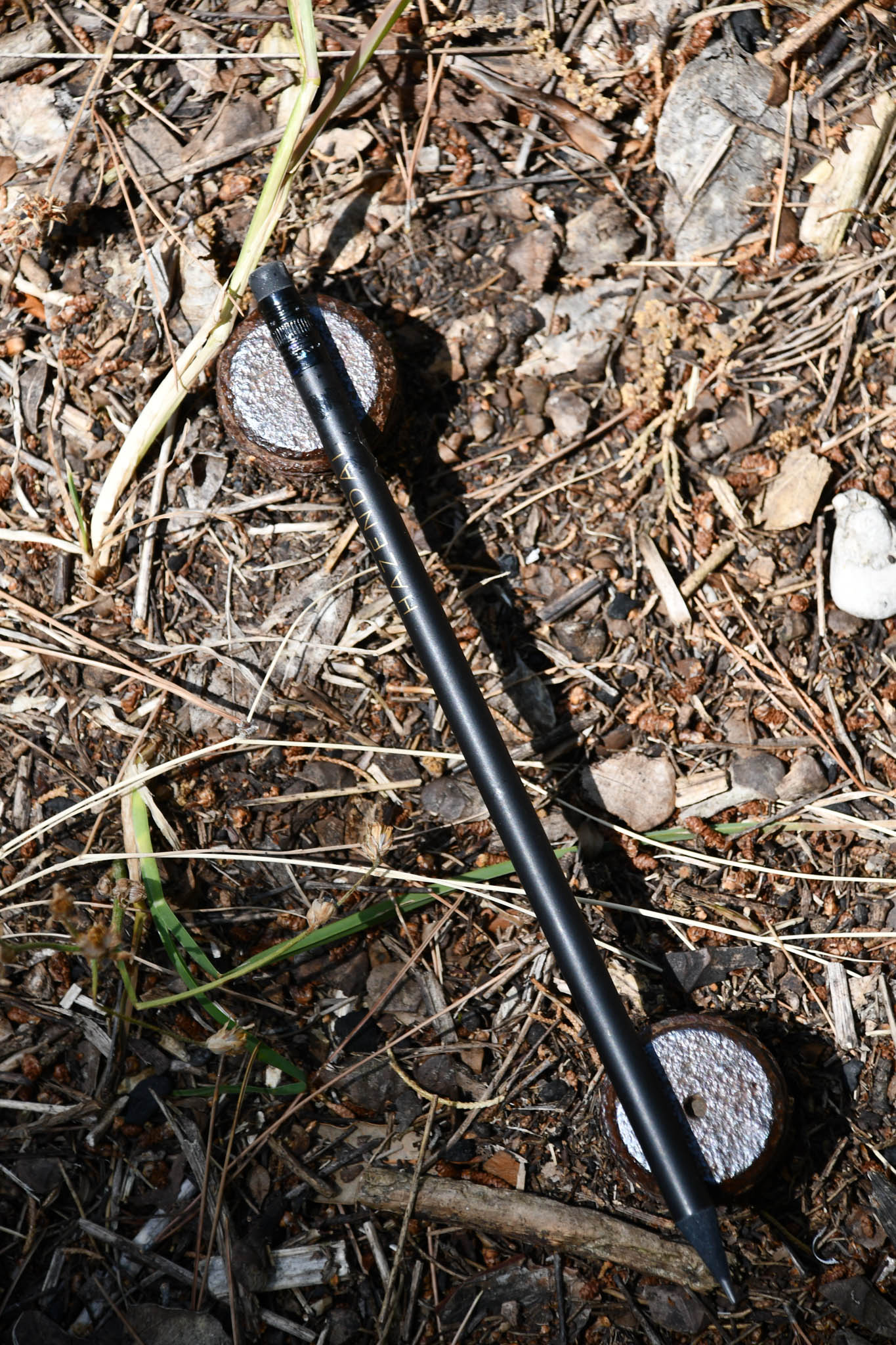
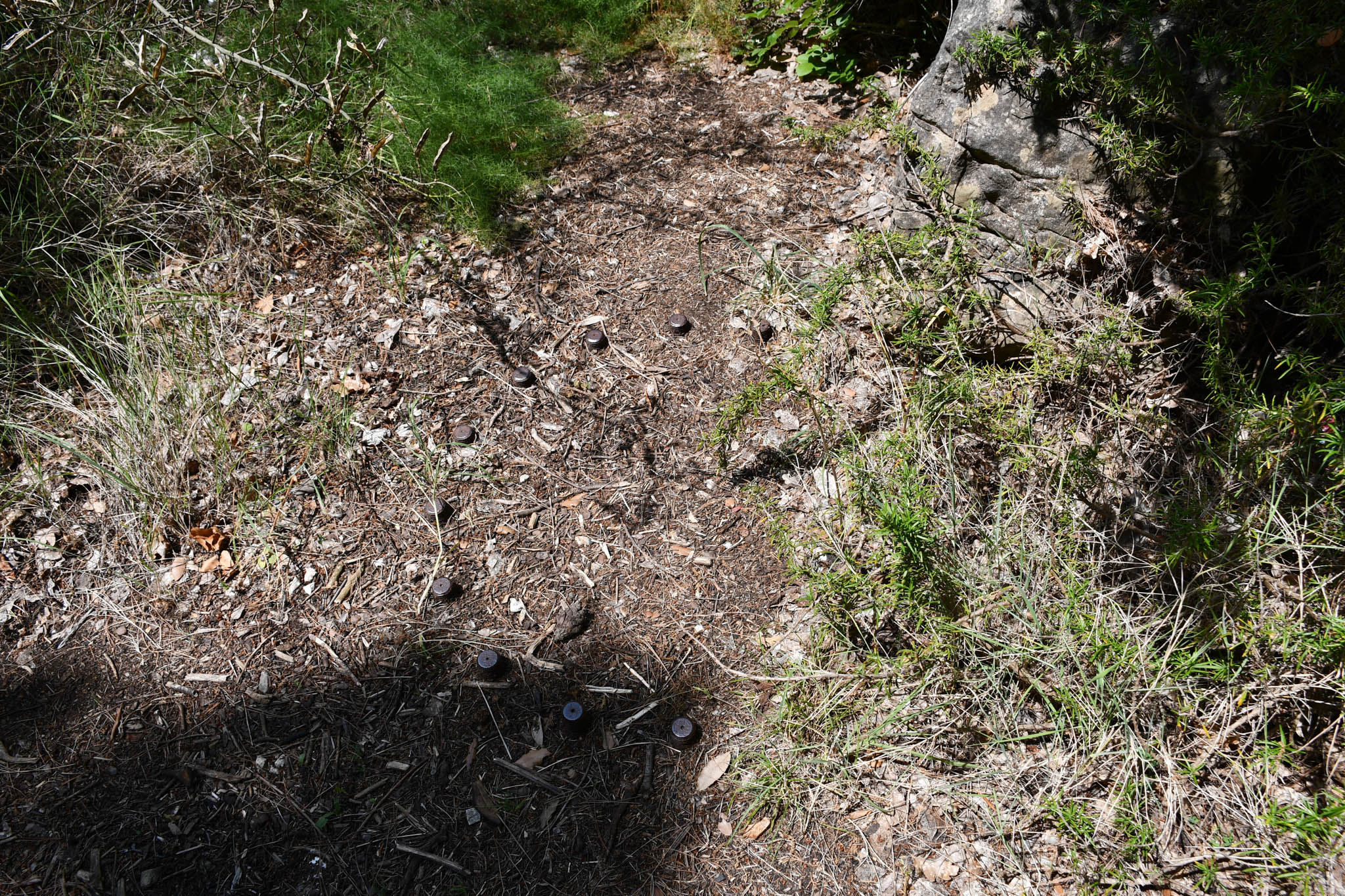
The gun emplacements are around 2m to 3m in diameter, with a cement doughnut floor. One has 10-12 30mm diameter bolts embedded in the concrete.

Figure 5:A: Bolts in concrete; B: Detail of a bolt; C: Tunnel entrance opening directly into a gun emplacement position; D: Concrete doughnut and surrounding parapet; E: Alcove in parapet.
Figure 6: Lower-level Plan. This plan is based on rough drawing while in the tunnels and without any surveying instruments or measuring tape. |

Figure 7: Upper-level Plan. This plan is based on rough drawing while in the tunnels and without any surveying instruments or measuring tape. |

Construction Techniques
The tunnels were excavated into limestone bedrock and subsequently lined with cast concrete. Throughout the complex, the walls and arched ceilings preserve clear impressions of timber shuttering used during construction. These formwork marks are a distinctive feature of the site.
All passages and rooms employ arched roofs, a common military engineering solution that distributes loads efficiently and provides resistance against blast effects. The rooms are generally rectangular, measuring approximately 2–3 metres wide and 4m to 6m long, with ceiling heights reaching about 3 metres at the apex of the arch..
Several features occur throughout the tunnels. Channels recessed into the walls approximately 1.6 metres above floor level contain remnants of timber beams measuring roughly 10 cm by 5–6 cm in section. Their purpose is uncertain. They may have supported cable trays, utility conduits, shelving, or internal timber fittings.
Rows of small attachment points, often accompanied by traces of red paint, run along many passages. These are consistent with supports for electrical wiring or communications cables. The extensive use of such fittings suggests that the position was electrically equipped rather than merely serving as a passive shelter.
Particularly noteworthy is evidence for waterproofing. In several locations, black tar is visible between the concrete lining and surrounding rock. Tar can be seen leaking above doorways and pooling on floors where it has softened over time. Such waterproof membranes were commonly employed in military tunnel construction to reduce water ingress.
Figure 8: A:Timber formwork impressions preserved in the tunnel walls; B: Entrance arch and external stone work of the main entrance; C: Tar sheeting visible above a door frame; D: Channel in wall which still contains a wooden beam; E: Tar seep on the floor. |

Purpose
The purpose of the tunnel complex can be inferred from its layout, location and surviving surface features.
Three tunnel exits emerge directly into circular concrete platforms surrounded by low stone parapets. One emplacement contains a circular arrangement of large anchor bolts approximately 30 mm in diameter. These almost certainly secured the mounting of a weapon or associated equipment. So many heavy-duty bolts suggest a medium to heavy weapon mount. The small circumference implies that the supporting concrete must be quite deep.
The arrangement strongly suggests that the tunnels were constructed to support coastal artillery positions. The underground rooms would have provided protected accommodation for ammunition, communications equipment and operating personnel, while the observation post would have enabled target acquisition and fire correction.
Figure 9: A: Bolts in the base of a gun emplacement; B: Detail of a single bolt with pencil for scale; C: Tunnel entrance opening on to a gun emplacement; D: Surrounding parapet; E: Alcove in parapet. |
The presence of a possible control room and cable fittings indicate a coordinated defensive installation rather than isolated gun pits. The system appears designed to connect multiple weapon positions through a protected underground network.
This interpretation is supported by local historical testimony. The tunnels connect former artillery positions from around 1943 onwards. (Varina Jurica Turk, Pers. comm.)
The complex also fits a broader pattern seen along the Croatian coast. Following the Second World War, Yugoslavia constructed numerous tunnel-connected coastal artillery positions intended to defend the Adriatic shoreline and key naval approaches. Many were directed towards potential threats from the west during the early Cold War period. (CIA)
Construction History
The precise construction history remains incompletely documented, but available literature points to a World War II Italian origin, (Varina Jurica Turk, Pers. comm.) although modifications during the post-war period are probable. “It is likely that during this period, and certainly by September 1943, a coastal artillery battery was constructed in the immediate vicinity of the chapel [near the point of Sustjepan.]” (Varina Jurica Turk, pers. Comm.)
Their concrete construction, electrical infrastructure and overall design are characteristic of Yugoslav military engineering of the late 1940s and early Cold War era rather than Austro-Hungarian or inter-war fortifications which may indicate a later upgrading of the facilities.
Particularly significant are declassified American intelligence reports indicating that a coastal defence position at Cavtat had been completed by 1949. Local sources date the original complex at Rat, a peninsula just east of Sustjepan, to around 1943. Although the surviving CIA documents do not provide detailed descriptions of the tunnel system itself, they place military construction activity in the area within the immediate post-war period. This was probably a modernisation programme.
This timing corresponds with a wider programme of Yugoslav coastal fortification. Throughout the late 1940s, military engineers constructed underground artillery positions, bunkers and observation posts at strategic locations along the Adriatic coast. Similar installations elsewhere in Croatia were excavated into rock and protected by reinforced concrete. (CIA)
The tunnels continued to have military value long after their original construction. Local historical sources indicate that they were still being used during the occupation of Cavtat in 1991 during the Croatian War of Independence. (Hrvatska katolička mreža)
Today the site stands abandoned but largely intact. Despite decades of neglect, the tunnels preserve valuable evidence of Yugoslavia's early Cold War defensive preparations and offer a rare opportunity to study a relatively untouched coastal artillery position.
Recent Use
Figure 10: A: Remnants of bag suspension in the twilight zone of the main passage; B: The straw contents from a bag; C: Bottle neck suspended from a wall, with remnants of a plastic bag; D & E: Perforated plastic bags filled with straw (See B). |

Some of the rooms and passages on the lower level contained piles perforated plastic bags, filled with straw. Some bags had cut-off plastic cool drink bottles tied into the tops of the bags. Along one wall of the main entrance passage, the remnants of bottles and bags were suspended from nails by bits of wire and string.
This appears to be an attempt at mushroom cultivation. (Saludares & Marin, 2025), (Nieuwenhuijzen, 2005). Although the light conditions may have been good for mushroom farming, the dry and dusty atmosphere in the tunnels was not conducive to optimal mushroom growing conditions.
Current Inhabitants
While we did not see any humans in the tunnels during our visit, we did find a number of residents. There were a number of daddy long-leg spiders, probably of the family Pholcidae. These occurred through-out the tunnel complex. A moth with highly reflective eyes occurred in some of the permanently dark parts of the tunnels that were still quite close to the tunnel entrances. They are probably of the genus Hypena.
Finally, the only mammal we found in the tunnels was a lonely horseshoe bat of the genus Rhinolophus. The bat was hanging on the underside of the observation post platform. It was not there during my first two visits, but was there on the third visit.
Figure 11: A: Rhinilophus bat; B: Hypena moth; C: Pholcidae spider. |

Conclusion
The Cavtat coastal defence tunnels represent a remarkably well-preserved example of post-war Yugoslav military engineering. Their combination of underground galleries, artillery positions, communications facilities and observation post reflects a carefully integrated defensive system rather than a simple bunker complex.
While many questions remain unanswered—particularly concerning the weapons installed there and the exact date of construction—the available evidence strongly suggests a late-1940s coastal artillery position built as part of Yugoslavia's wider Cold War defence network. Continued archival research in Croatian, Serbian and former Yugoslav military records may yet reveal the full history of this overlooked site.
Although the exact origins of these tunnels are uncertain, these defence installations remain powerful reminders of times when the Adriatic shores were fortified against potential invasion. This site is remarkably well-preserved and easily reachable from town, it offers visitors a tangible connection to the maritime and coastal defence strategies of the past.
With only modest investment, some clearing of overgrowth, informative signage, and basic lighting, this location could become an engaging stop for history enthusiasts, military buffs, and curious travellers alike. In a region already celebrated for its natural beauty and cultural heritage, these silent concrete sentinels deserve to be remembered and shared as an authentic piece of 20th-century Adriatic history.
References
Anonymous CIA Report. (1950, May) GUN EMPLACEMENTS AT CAVTAT
Anonymous CIA Report. (1950, July) FORTIFICATIONS ON YUGOSLAV COASTLINE
Varina Jurica Turk, prof. Ravnateljica MDRD
Nieuwenhuijzen, B. (2005). Small-scale mushroom cultivation: Oyster, shiitake and wood ear mushrooms. Agromisa Foundation and CTA (Agrodok-series No. 40).
Saludares, G. G., & Marin, M. B. (2025). Oyster Mushroom Cultivation Through Agricultural Waste Amendment and Application of Misting Concoctions. Central Mindanao University Journal of Science, 29(2), 20-28.
Survey Plans
Photos